20 August 2026
A Wholesale Percussion Suppliers Guide for Serious Buyers

A Wholesale Percussion Suppliers Guide for Serious Buyers
The fastest way to source profitable wholesale percussion is to lock down your supplier type, request targeted samples, and calculate landed cost before you ever commit to a bulk order. Most retail, education, and private-label buyers land in one of three lanes: a manufacturer for OEM runs, a distributor or importer for stocked inventory that needs fast restock, or a trading company for mixed-SKU assortments shipped in one consolidated container.
Two things to do this week:
- Request a representative sample plus a written sample specification sheet, so what arrives on the pilot pallet matches what you’ll get on the full container.
- Build a landed-cost worksheet before you compare a single ex-factory price. Bulk purchasing only saves real money when demand is predictable and specs are standardized, not just when the per-unit quote looks low.
If you want a direct trade route instead of building a sourcing pipeline from scratch, Temple of Sound runs a trade account program for retailers and education buyers that skips much of the vetting below.
Key Takeaways
Profitable wholesale percussion sourcing depends on matching supplier type to your channel, verifying quality through samples before bulk commitment, and modeling landed cost rather than ex-factory price alone.
| Point | Details |
|---|---|
| Match supplier to channel | Choose manufacturers for private-label, distributors for fast restock, and trading companies for mixed SKUs. |
| Sample before you scale | Request a spec sheet, reference photos, and a test-play checklist with every sample order. |
| Calculate landed cost first | Include freight, duties, insurance, and inland delivery before comparing any ex-factory quote. |
| Vet with documentation | Ask for ISO or third-party audit reports and put acceptance criteria in writing before deposits. |
| Watch red flags closely | Vague factory details, no-sample policies, and below-market pricing signal risk together. |
| Start with a trade account | Temple of Sound offers trade pricing, curated brands, and sample support for retail and education buyers. |
Table of Contents
- Which Supplier Type Fits Your Channel?
- How Do You Define SKUs and Sample Requirements Before Quoting?
- What Should a Supplier Vetting Checklist Include?
- How Do You Compare Quotes Using Landed Cost?
- Which Shipping Mode and Incoterms Make Sense for Percussion Gear?
- How Do You Turn a Pilot Order Into a Repeatable Supplier Program?
- Temple of Sound’s Trade Capabilities for B2B Buyers
- What Red Flags Signal a Risky Wholesale Percussion Supplier?
- What Do Warranty and Return Policies Typically Cover?
- The Procurement Playbook Beats the Vendor Checklist
- Ready to Open a Trade Account With Temple of Sound?
- Frequently Asked Questions
- Sources
Which Supplier Type Fits Your Channel?
Your channel decides your supplier, not the other way around.
Manufacturers win on unit cost at scale and are the only realistic route for private-label drumsticks, branded cymbal packs, or custom hardware. Expect tooling setup costs and MOQs that only make sense once you’re ordering in the thousands of units.
Trading companies handle mixed-SKU orders well, consolidating drum kits, cymbals, hand percussion, and hardware into one shipment. The tradeoff is a layer between you and the factory floor, so ask directly which plants produce your goods and whether the trader can share OEM/private-label and sample evaluation support rather than just reselling stock.
Distributors and importers already hold inventory in-region, which suits retailers who need fast restock or want stocked demo units in customers’ hands quickly. You pay a premium per unit for that speed.
Artisan and premium makers fit boutique retail: lower MOQ, higher unit price, and a story worth telling on the shop floor.

How Do You Define SKUs and Sample Requirements Before Quoting?
Get quotes broken out by product family before you compare a single number. A full drum kit quote and a cymbal-pack quote hide very different cost structures if you lump them together.
- Separate your RFQ by category: complete kits, cymbals, hand percussion (djembes, congas, cajons), hardware, and accessories. Mixing them in one quote request makes supplier comparison nearly impossible.
- Expect MOQ ranges to vary sharply by category and supplier type. Finished-stock hand percussion from a distributor might ship at a few dozen units; custom cymbal alloys from a manufacturer often start in the hundreds.
- Send suppliers a sample request that includes a written spec sheet, reference photos, packaging expectations, and a short test-play checklist covering tuning stability and hardware fit.
- Ask for carton dimensions, units per carton, and weight per carton up front. Oversized drum shells and cymbal cases get billed on volumetric weight, and that number can quietly erase whatever discount the ex-factory price offered.
What Should a Supplier Vetting Checklist Include?
Copy this into your procurement workflow before any purchase order past a pilot batch.
- Request third-party audit reports or ISO 9001 documentation and verify certificate numbers directly with the issuing body, not just the supplier’s PDF.
- Confirm market-relevant certifications: CE and RoHS/REACH for European sales, ISPM-15 for any wooden packaging or drum shells crossing borders. Verifying these before high-volume orders is standard practice for regulated markets.
- Run a physical sample inspection against a short checklist: finish quality, joint and fit tolerance, tuning stability under tension, and hardware robustness (lugs, hoops, tension rods).
- Ask for export references and proof of experience with your specific incoterms. A factory that’s never handled DDP shipments to your country will learn on your order, not before it.
- Track response time, on-time delivery rate, and defect rate on the pilot order as hard KPIs, not gut-feel impressions.
Pro Tip: Put acceptance criteria in writing before you pay a deposit. “Tuning holds for 48 hours after shipping-tension release” is a testable claim; “good quality hardware” is not, and it’s the difference between a fast claim resolution and a monthslong dispute.
How Do You Compare Quotes Using Landed Cost?
Ex-factory price is the least useful number on any quote. Landed cost is what actually determines margin, and it has six components: ex-factory price, export packing, freight, duties, insurance, and inland delivery to your warehouse or store.
| Cost Component | What It Covers |
|---|---|
| Ex-factory price | Unit cost at the supplier’s dock, before anything else |
| Export packing | Carton, palletization, and protective materials for transit |
| Freight | Ocean, air, or rail cost, often billed on volumetric weight for bulky items |
| Duties and tariffs | Import taxes set by your destination country’s customs schedule |
| Insurance | Cargo coverage against loss or damage in transit |
| Inland delivery | Port-to-warehouse or port-to-store trucking |
Model three order quantities side by side, small pilot, first bulk, and a full container, and watch where the per-unit cost actually flattens out. Bulk buying only pays off once volume, packaging efficiency, and standardized specs line up; a container that’s half-empty because your SKUs don’t palletize well can cost more per unit than a smaller LCL shipment. Negotiate phased shipments or an annual volume commitment before accepting the first tooling or setup fee a manufacturer quotes.
Which Shipping Mode and Incoterms Make Sense for Percussion Gear?
Full-container-load (FCL) makes sense once you’re filling a container with standardized cartons of drums or cymbals; it’s the cheapest per-unit freight option but ties up cash in a large order. Less-than-container-load (LCL) suits smaller or mixed-SKU pilot orders where you’re not ready to commit to a full container yet. Air freight only makes sense for urgent restocks or lightweight accessories, since large drum shells and cymbal cases get punished hard by volumetric air pricing.
- Confirm who bears which cost and risk under your incoterm: EXW puts nearly everything on you, FOB shifts freight risk to the buyer once goods clear the origin port, and DDP puts duties and delivery on the supplier.
- Palletization matters more for percussion than most goods categories; unbalanced pallets of drum shells shift in transit and arrive with hairline cracks or dented hardware.
- Plan shipment timing around school procurement cycles and holiday retail peaks. A container that clears customs two weeks late during back-to-school season is a lost selling window, not just a delay.
How Do You Turn a Pilot Order Into a Repeatable Supplier Program?
A pilot order that goes well is a start, not a finish line.
- Build a simple supplier scorecard tracking quality consistency, on-time delivery, responsiveness to inquiries, and how claims get resolved.
- Negotiate staged commitments: pilot batch, then first bulk order, then rolling orders tied to actual sell-through, so cash isn’t locked into inventory that hasn’t proven demand yet.
- Write defect-claim SLAs, replacement terms, and lead-time commitments directly into the purchase order, along with the packaging specs you already confirmed during sampling.
- Keep a backup supplier qualified in parallel and carry enough safety stock to cover one missed shipment window without leaving shelves empty.
Temple of Sound’s Trade Capabilities for B2B Buyers
Temple of Sound runs trade accounts built around the same checklist above: curated brands, trade pricing, and hands-on support during sample evaluation rather than a self-serve catalog you’re left to interpret alone.
- Trade pricing tiers scaled to order volume, with sample evaluation support before any bulk commitment.
- A custom stick builder workflow that doubles as a private-label pipeline for retailers wanting branded drumsticks without building manufacturing relationships from zero.
- Curated cymbal packs assembled for retail shelf presentation, not just raw wholesale units.
Buyers consistently underestimate how much a pilot order and a documented sample inspection protect margin later. The suppliers worth scaling with are the ones who don’t flinch at a written acceptance checklist.
What Red Flags Signal a Risky Wholesale Percussion Supplier?
The suppliers who disappear after the first payment almost always show warning signs earlier, if you know where to look.
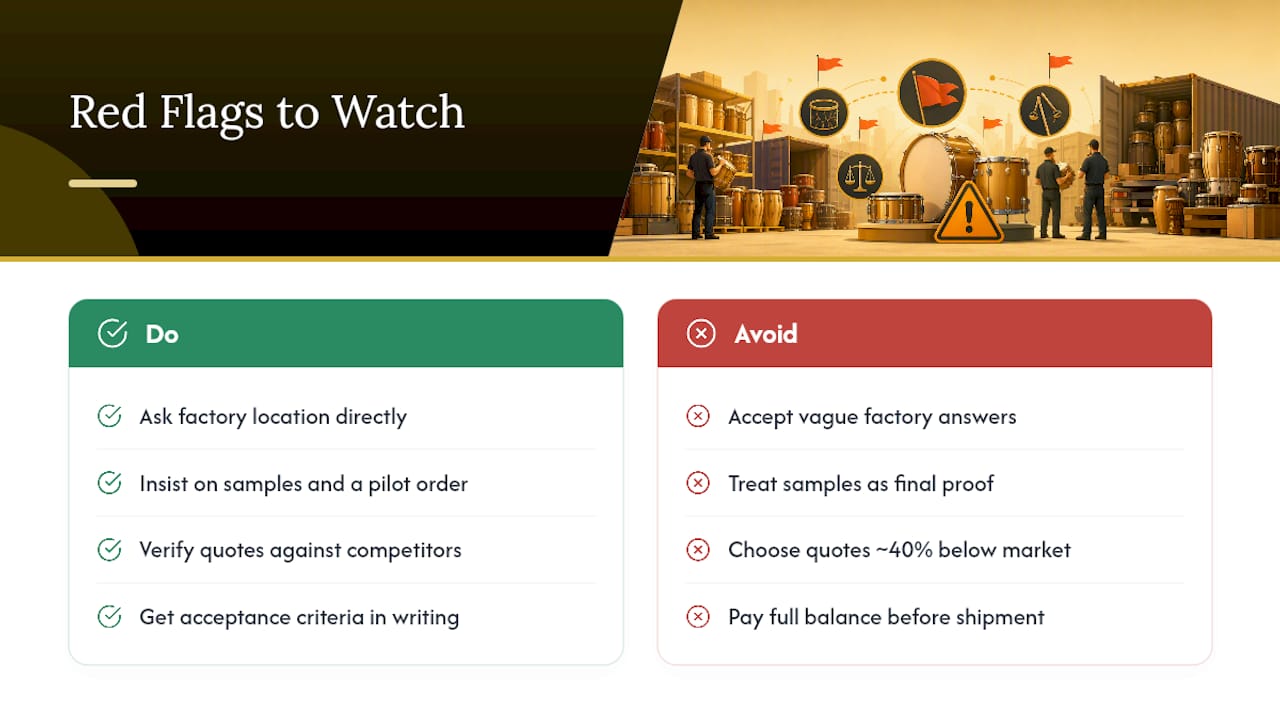
Vague or evasive answers about factory location are the clearest signal. A trading company that won’t name which plant actually produces your cymbals or drum shells is hiding something, usually inconsistent quality control across multiple subcontracted factories. Ask directly and expect a straight answer.
Refusal to provide samples, or samples that arrive noticeably better than the bulk order that follows, is a documented pattern in wholesale sourcing generally. This is exactly why a pilot order matters more than a glowing reference call.
Watch pricing that’s dramatically below every competing quote for the same specification. Percussion manufacturing has real cost floors: brass and bronze alloy for cymbals, hardwood for drum shells, precision tooling for hardware. A quote 40% under everyone else usually means thinner metal, unseasoned wood, or a substitution you won’t discover until the finish cracks or the tuning won’t hold.
Other signals worth weighing seriously: no willingness to put acceptance criteria in writing, pressure to pay full balance before shipment rather than staged deposits, inconsistent communication that shifts between sales reps with no continuity, and an inability or unwillingness to produce any certification documents when you ask for RoHS, REACH, or ISO paperwork. None of these alone is disqualifying, but two or more together should slow you down considerably.
What Do Warranty and Return Policies Typically Cover?
Warranty terms in percussion wholesale vary far more than in most product categories, largely because “defect” means different things for a cymbal versus a drumhead versus hardware.
Most manufacturers warranty against manufacturing defects, cracked cymbal bells from a casting flaw, warped shells, faulty lugs, for a period ranging from 90 days to a year, but explicitly exclude normal wear. A cymbal that develops keyholing from years of stick contact isn’t a warranty claim; a cymbal that cracks radially within its first month of light use likely is.
Drumheads and consumable accessories typically carry little to no warranty coverage at all, since they’re wear items by design. Hardware, stands, pedals, and mounting systems usually get the strongest warranty terms because failure points are mechanical and easier to attribute to manufacturing versus use.
Return policies for wholesale orders differ sharply from retail returns. Expect no blanket “return for any reason” policy on bulk orders. Instead, returns hinge on the written acceptance criteria established during sampling, if the bulk shipment doesn’t match the approved sample on tuning, finish, or hardware fit, that’s a claim, not a discretionary return. This is precisely why documenting acceptance criteria in the purchase order matters more than any verbal assurance a sales rep gives you.
The Procurement Playbook Beats the Vendor Checklist
Most sourcing guides hand buyers a vendor list and call it done. That’s backwards. The suppliers on any given list change constantly, but the sequence that protects your margin, sample first, calculate landed cost second, pilot before bulk third, doesn’t change regardless of which factory or trading company you end up working with.
The overrated piece of conventional advice is chasing the lowest ex-factory quote. Buyers who anchor on that number consistently get burned by volumetric freight surprises or duty schedules they didn’t model, and by the time the container clears customs, the “cheap” supplier costs more per unit than the one they passed over.
What the evidence actually supports: standardize your specs before you request quotes, not after. Suppliers quoting against a loose brief will always come in lower than suppliers quoting against a detailed spec sheet, because the loose quote hides the corners that will get cut. Prioritize the sample inspection and the landed-cost worksheet over supplier reputation claims you can’t verify independently. Reputation matters eventually. It shouldn’t be the first filter.
Ready to Open a Trade Account With Temple of Sound?
If the checklist above feels like a lot of infrastructure to build before your first container even ships, that’s the actual cost of sourcing cold from unfamiliar factories. Temple of Sound offers a shorter path for retailers and education buyers who’d rather skip building a vetting pipeline from scratch: trade pricing, curated brand selection, and direct support evaluating samples before you commit to volume.

The practical next steps are straightforward. Open a trade account to access wholesale pricing and product documentation, request a sample pack or a landed-cost estimate for the SKUs you’re considering, and ask directly about MOQs and current lead times for drumsticks, cymbal packs, and accessories. If private-label drumsticks fit your retail strategy, the custom stick builder gives you a configured product line without the tooling negotiation a manufacturer relationship usually demands.
Frequently Asked Questions
What’s the difference between a manufacturer and a trading company for wholesale percussion?
A manufacturer produces the goods directly and offers the lowest unit cost at scale, but usually requires higher MOQs and tooling setup for custom work. A trading company consolidates orders across multiple factories, which suits mixed-SKU purchases but adds a layer between you and actual production quality control.
How do I calculate landed cost for a percussion order?
Add ex-factory price, export packing, freight (often billed on volumetric weight for bulky items like drum shells), duties, insurance, and inland delivery to your warehouse. Compare that total per-unit figure across at least three order quantities to see where bulk buying actually saves money.
What MOQ should I expect from a wholesale percussion supplier?
MOQ ranges vary by category and supplier type. Finished-stock hand percussion from a distributor might start at a few dozen units, while custom cymbal alloys or branded drumstick runs from a manufacturer often require several hundred units minimum.
How do I protect myself before placing a bulk percussion order?
Request a physical sample against a written spec sheet, run a pilot order before committing to a full container, and put acceptance criteria for tuning, finish, and hardware fit directly into the purchase order.
What certifications should wholesale percussion suppliers have?
Depending on your market, check for CE and RoHS/REACH compliance for European sales, ISPM-15 for wooden packaging crossing borders, and ISO 9001 or third-party audit documentation as general manufacturing reliability indicators.