13 August 2026
Hi Hat Weights for Drummers: What the Numbers Mean

Hi Hat Weights for Drummers: What the Numbers Mean
Most 14" hi-hat tops generally weigh in a moderate light-to-medium range, with bottoms noticeably heavier to balance the pair. That weight gap is not arbitrary. The heavier the cymbal, the louder and longer it sustains. The lighter it is, the faster it responds and the more stick definition you hear. Every gram you add or subtract shifts that balance.
Quick reference for the most common sizes and configurations:
- 13" top: commonly light | 13" bottom: slightly heavier
- 14" top: commonly light to medium | 14" bottom: noticeably heavier
- 15" top: medium weight | 15" bottom: heavier
- Matched pair (14"): top and bottom weights close to each other
- New Beat-style (14"): bottom significantly heavier than the top
Key Takeaways
The single most important rule: a 14" hi-hat top in the 800–1,100 g range and a bottom 200–400 g heavier will cover the majority of playing contexts, with the ratio fine-tuning the chick character.
| Point | Details |
|---|---|
| Standard 14" weight ranges | Tops typically run 800–1,100 g; bottoms run 1,000–1,500 g for most production pairs. |
| Top:bottom ratio matters | Most pairs fall between 60–80%; a 67–71% ratio (New Beat-style) gives a sharp, defined chick. |
| Heavier = louder and longer | More mass raises volume and sustain; lighter cymbals respond faster with more stick articulation. |
| Genre alignment | Jazz favors lighter tops (~800–950 g); rock and metal favor heavier pairs with wider weight spreads. |
| Templeofsound measured stock | Alchemist Cymbal pairs are weighed individually before shipping so you know the exact ratio upfront. |
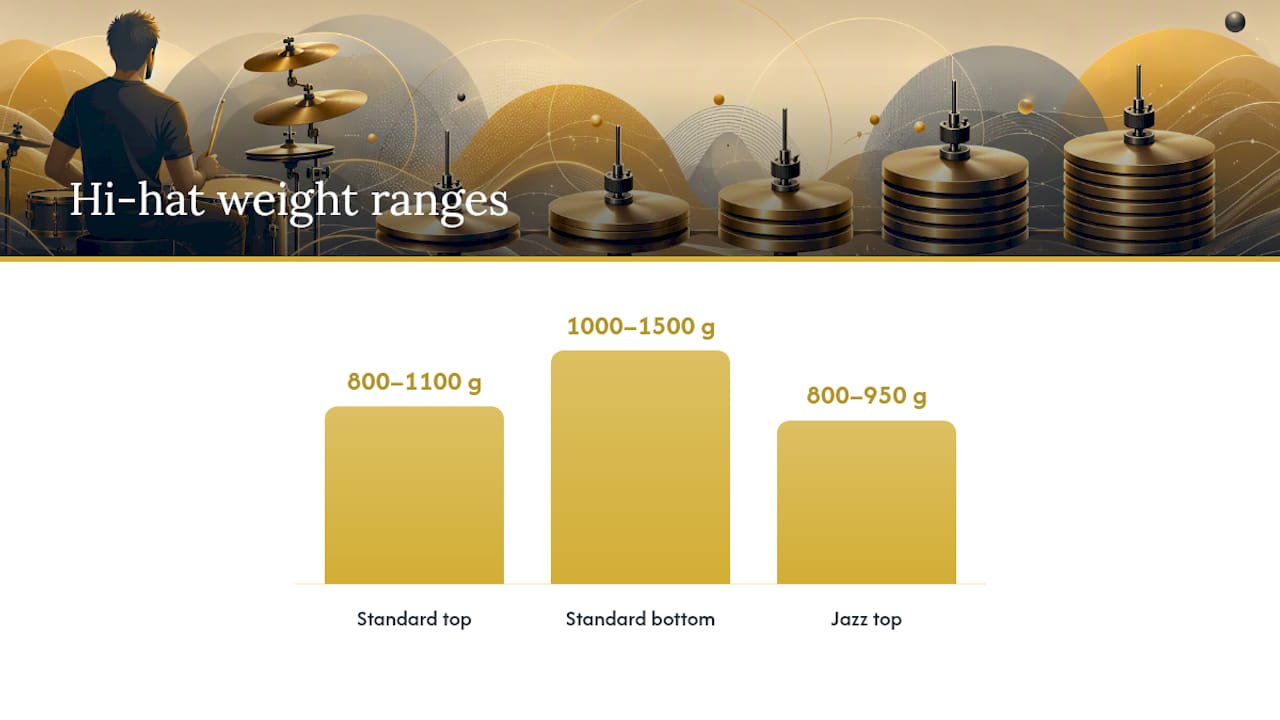
Table of Contents
- How hi hat weights shape tone, feel, and dynamic response
- Weight ranges by size: a quick reference chart
- Top:bottom ratios, matched pairs, and the New Beat setup
- Which hi-hat weights suit which genres?
- Which cymbal goes on top, and what happens when you flip them?
- How to measure a hi-hat’s weight and read manufacturer specs
- Templeofsound sample: how we measured and what we found
- Weight numbers are a starting point, not a verdict
- Curated, measured hi-hat pairs from Templeofsound
- Sources
How hi hat weights shape tone, feel, and dynamic response
The physics here are straightforward. More mass means the cymbal resists deflection, which translates to higher volume, longer sustain, and a narrower, more focused frequency range. According to Paiste’s cymbal sound classification system, weight and size interact directly: as thickness increases, volume and sustain rise while the frequency range narrows. Larger diameter darkens the color and adds sustain on top of that.
For hi-hats specifically, the top and bottom cymbals each carry a different job.
- Top cymbal: Sets the tonal color, stick definition, and response speed. A lighter top opens up faster, gives you crisper 16th notes, and produces a brighter, more articulate sound. A heavier top pushes back against the stick more, producing a fuller, more projected tone.
- Bottom cymbal: Drives the chick (the closed-hat sound from the foot pedal), body, and sustain. A heavier bottom with a pronounced edge creates a sharper, more cutting chick. It also adds mass to the air column between the two cymbals, which affects how the open sound blooms and decays.
- Top-bottom difference: A moderate spread between top and bottom cymbals is common in production pairs, contributing to their characteristic chick sound.
According to Drumming Base, thin tops favor articulation and response, while heavier bottoms with additional mass push more air and sharpen chick definition. That is the core trade-off you are always managing.
Pro Tip: When you are deciding between two tops, close your eyes and play a single-stroke roll at medium tempo. The one that feels like it “gets out of the way” faster is the lighter one. That physical sensation is more reliable than reading the spec sheet.
Weight ranges by size: a quick reference chart
The table below uses reference bands drawn from DrumHelper’s cymbal weight data and CymbalUtopia’s weight classification table, which maps grams to categories from extra light through extra heavy by diameter.
| Size | Typical top range (g) | Typical bottom range (g) |
|---|---|---|
| 13" | 800–950 | 850–1,100 |
| 14" | 800–1,400 | 1,000–1,600 |
| 15" | 950–1,200 | 1,100–1,600 |
| 16" | 1,100–1,500 | 1,300–1,600 |
The 14" row shows the widest spread because it covers everything from paper-thin jazz hats to thick, heavy rock pairs. A 14" top at 800 g sits in the extra-light band; one at 1,400 g is firmly heavy.
- A manufacturer listing a 14" top at 900 g is describing a medium-light cymbal. Expect fast response, moderate volume, and a bright, open tone.
- A bottom listed at 1,400 g or above is on the heavy end. Expect a sharp, projecting chick and significant sustain when open.
- When a spec sheet gives only one weight for a “pair,” divide by two as a rough estimate, then verify with a scale before buying if the exact split matters to you.
Top:bottom ratios, matched pairs, and the New Beat setup
The ratio of top weight to bottom weight is one of the most useful numbers in hi-hat selection, and it is almost never printed on the box.
Matched pairs have tops and bottoms within roughly 50–100 g of each other, sometimes identical. These pairs tend to produce a balanced, washy, blended sound with a softer chick. They work well in jazz and lower-volume settings where you want the open hat to breathe evenly.
New Beat-style pairs deliberately mismatch the weights. Community-measured data from Music Stack Exchange shows that top:bottom ratios in measured pairs cluster around 70%, with a range of roughly 60–80%.
In a community-collected sample of hi-hat pairs, the average top:bottom weight ratio was within a range commonly seen among production pairs, with individual pairs varying moderately.
What does moving that ratio actually do?
- Narrower spread (closer to 1:1): Softer, blended chick; more wash on open strokes; suits lower-volume and jazz applications.
- Wider spread (top at 60–67% of bottom): Sharper, more cutting chick; tighter, more defined open sound; suits rock, funk, and live projection.
- Flipping the ratio (heavier cymbal on top): Produces a heavier, more pronounced stick attack and a different chick character. Some players do this deliberately for a thicker, more aggressive sound.
The ratio also matters when you mix cymbals from different pairs. A bottom from a heavy rock pair under a light jazz top can produce a surprisingly usable hybrid, but the chick will be dominant and the open sound will close faster than expected.
Which hi-hat weights suit which genres?
Weight choices are not universal. The right pair for a jazz trio sounds wrong in a metal band, and vice versa.
- Jazz and low-volume work: Light tops (800–950 g for 14") and medium bottoms (1,000–1,200 g). The priority is fast response, articulate stick definition, and a soft, blended chick that does not overpower the ensemble. Matched or near-matched ratios work well here.
- Funk and R&B: Medium tops (900–1,050 g) with a heavier bottom (1,200–1,400 g). You want a crisp, cutting chick for ghost-note grooves and enough projection to sit in a dense mix. A ratio around 70–75% delivers that.
- Rock: Medium-heavy tops (1,000–1,200 g) and heavy bottoms (1,300–1,500 g). Volume and projection matter more than speed. The heavier mass carries over loud guitars and gives the chick real authority.
- Metal: Heavy to extra-heavy tops (1,100–1,400 g) and very heavy bottoms (1,400–1,600 g). Fast double-bass patterns demand a tight, fast-closing chick with minimal wash. The weight keeps the sound controlled at high tempos.
- Studio recording: This is where lighter hats often surprise people. A lighter top produces more transient detail, which translates well to close-mic recording. If the room is treated and you are recording at moderate levels, a 14" top in the 850–950 g range often captures more nuance than a heavier one. Understanding how room acoustics interact with sustain matters here: a heavier, longer-sustaining hat can accumulate room reflections in ways that muddy a mix.
Pro Tip: Before committing to a pair, play them with your actual band or a backing track at performance volume. A hat that sounds perfect in a quiet shop can disappear in a loud mix, or a light pair that sounds thin alone can open up beautifully in context.
Which cymbal goes on top, and what happens when you flip them?
Convention puts the lighter, thinner cymbal on top. There are two practical reasons: the top cymbal needs to move freely on the stand rod, and the manufacturer voices the pair with that orientation in mind. The bottom sits on the stand’s tilter, angled slightly upward, and its heavier mass is what creates the chick when the two cymbals meet.
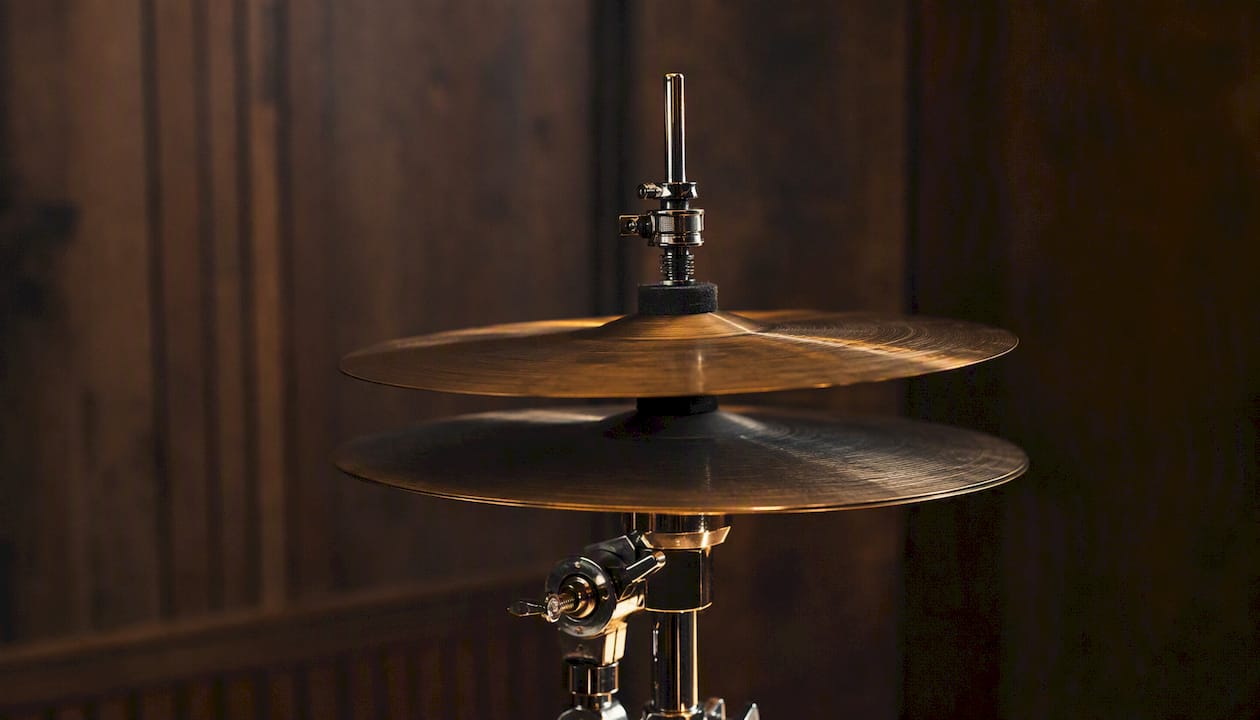
According to Drumming Base, tops are commonly 800–1,100 g and bottoms 1,200–1,500 g, with a typical difference of 200–300 g. That gap is intentional.
Flipping the cymbals, placing the heavier one on top, changes several things at once. The stick attack becomes heavier and more pronounced. The chick loses some of its snap because the lighter cymbal is now doing the striking from below. Some players use this deliberately for a thicker, more aggressive open sound, particularly in heavier genres.
Other creative setups worth knowing:
- Two tops: Using two top cymbals (both lighter, often from different pairs) produces a very fast, washy, almost trashy sound. Popular in jazz and experimental contexts.
- Orphan bottom swaps: Swapping just the bottom from a different pair is one of the most cost-effective ways to tune a pair’s character. A heavier bottom under your existing top sharpens the chick without changing the stick feel.
Before experimenting, check three things: the stand rod fits the top cymbal’s hole without keyholing, the clutch height still works, and you weigh both cymbals before swapping so you know exactly what ratio you are creating.
How to measure a hi-hat’s weight and read manufacturer specs
A digital kitchen scale or postal scale accurate to 1 g is all you need. Place one cymbal at a time on the scale, centered and flat, and record the reading. Weigh the top and bottom separately. Never weigh them together and divide, because the split is rarely equal and that is the number you actually need.
Manufacturer specs vary in how they present weight. Some list each cymbal individually; others give a combined pair weight. When a spec sheet shows only one number for a “pair,” treat it as a combined figure and verify with a scale before buying if the ratio matters to you.
Unit conversion is simple: 1 ounce equals approximately 28.35 g. A 14" top listed at 32 oz is roughly 907 g, which puts it in the medium range.
When weight labels are missing entirely:
- Check the manufacturer’s website product page. Most major brands list individual cymbal weights in grams.
- Ask the retailer to weigh the specific cymbal before shipping. Any serious percussion dealer should be able to do this.
- Use profile and finish as a rough guide: a visibly thin, heavily lathed cymbal is almost certainly under 950 g for a 14". A thick, unlathed or partially lathed cymbal is likely over 1,100 g.
Keep in mind that two cymbals with identical weights can still sound different. Hammering patterns, bell size, and lathe depth all shift the sound, as noted across DrumHelper’s weight reference data. Weight predicts behavior well, but it does not predict everything.
Templeofsound sample: how we measured and what we found
As part of Templeofsound’s distribution work with Alchemist Cymbals, a small set of 14" hi-hat pairs from current inventory was weighed on a calibrated digital scale (resolution: 1 g) in early 2026. Each cymbal was weighed individually, top and bottom recorded separately, and the ratio calculated.
| Pair | Ratio (top/bottom) |
|---|---|
| A | Approximately 70% |
| B | Around 70% |
| C | Around 70–75% |
| D | Around 60–67% |
| E | Approximately 75% |
- All pairs fell within a moderate top-to-bottom weight ratio range consistent with community data.
- Top and bottom weights vary independently and do not always scale proportionally.
- Each pair featured a significant weight difference between top and bottom, consistent with a New Beat-style spread.
This sample is small and inventory-biased, not a random cross-section of the market. Use it as a calibration check against manufacturer specs, not as a population average. The practical takeaway: if a pair you are considering falls within these ranges and ratios, it is behaving exactly as expected for a standard production hi-hat.
Weight numbers are a starting point, not a verdict
The numbers in this article are genuinely useful. That is worth having.
But weight does not tell you everything. The top cymbal tends to define tonal color; the bottom defines the chick and body. Two cymbals at identical weights can sound noticeably different because of how they were hammered, lathed, or aged. The numbers get you in the right neighborhood. Your ears close the deal.
My honest recommendation: use the weight ranges and ratios here to narrow your shortlist, then audition the actual pair in a musical context before committing. If you cannot play them live, ask your supplier to describe the ratio and confirm the individual weights. Any supplier worth buying from should be able to tell you both numbers without hesitation.
Curated, measured hi-hat pairs from Templeofsound
If you want to skip the guesswork on weights and ratios, Templeofsound stocks curated Alchemist Cymbal hi-hat pairs with individual weights confirmed before shipping. Every pair in the current range has been weighed top and bottom, so you know the ratio before it arrives at your door.

Whether you are after a matched pair for jazz, a New Beat-style setup for rock, or something in between, the team at Templeofsound can point you to the right weight profile for your playing context. Browse the current hi-hat selection at Templeofsound or reach out directly to ask about specific weights and ratios in stock.
Sources
- Cymbal Sound Classification System - Paiste
- Top vs Bottom Hi-Hat: Differences and Setup – Drumming Base
- How Much Do Cymbals Weigh | DrumHelper
- Cymbal weight table and Cymbals 101 - CymbalUtopia