24 August 2026
How to Set Up a Temple of Sound Drum Shop Account

How to Set Up a Temple of Sound Drum Shop Account
Apply directly through Temple of Sound’s trade application with your business registration, resale or tax ID, bank details, and at least one trade reference, and you’ll get an email confirmation with next steps, usually within a few business days. That’s the whole shortcut. The rest of this guide covers what to have ready before you click submit and what happens after.
Before you start the application, gather these:
- Business name and registered address
- Resale certificate, VAT number, or equivalent tax ID
- Bank account details for payment processing
- One or two trade references (other suppliers you’ve bought from)
- A working contact email for account correspondence
One thing catches new applicants off guard: most new trade accounts are asked to prepay their first order by card rather than get invoiced. Don’t read that as a red flag. It’s standard across the percussion and music trade, and it usually changes once you’ve placed a couple of orders.
Key Takeaways
A complete Temple of Sound trade account application, resale certificate, business registration, bank details, and trade references, get processed fastest and avoids the holds that delay most new accounts.
| Point | Details |
|---|---|
| Gather documents first | Resale certificate, business registration, bank details, and trade references before you open the form. |
| Expect prepay initially | New accounts commonly start on card prepayment until purchase history supports a tier upgrade. |
| Declare your sales channels | Marketplaces or off-price channels often need separate approval, so disclose them upfront. |
| Watch the inactivity window | Accounts left dormant for 12 to 24 months may need reactivation or a fresh application. |
| Apply through Temple of Sound | Get exclusive access to London Drumstick Co. and Alchemist Cymbals with B2B pricing and curated packs. |
Table of Contents
- Drum Shop Account Setup: What to Gather First
- How Do You Fill Out the Trade Application?
- What Discount Tiers and Fees Should You Expect?
- How Long Does Approval Take?
- Managing Your Account After Approval
- Why Register a Trade Account With Temple of Sound?
- The Real Bottleneck Isn’t the Form. It’s the Prep.
- Ready to Apply for Your Trade Account?
- Sources
Drum Shop Account Setup: What to Gather First
Getting your paperwork in order before you touch the application form saves you a week of back and forth. Distributors process trade accounts against a checklist, and missing even one item usually means a hold, not an outright rejection, but a hold still costs you time.
Here’s what to collect:
- Resale certificate or tax ID. This proves you’re buying for resale, not personal use, and it’s a near-universal requirement across dealer trade applications.
- Business registration documents. Articles of incorporation, a business license, or your sole proprietorship filing, depending on how you’re structured.
- Bank account details. Needed for processing prepayments and, later, for any credit terms you’re granted.
- Proof of business presence. A shopfront photo, a link to your website, or your storefront on a marketplace you actively sell through.
- Trade references. Two suppliers you already buy from, with a contact name and phone number or email for each.
If you run an online-only store rather than a physical shop, don’t assume that disqualifies you. Distributors increasingly treat an active website and consistent sales history as valid proof of business presence, the same way they’d treat a shopfront photo.
International applicants should expect wire transfers for larger orders and card payment for smaller ones, with bank fees typically falling on the applicant rather than the distributor. Confirm this before your first order lands, not after.
Pro Tip: Scan your trade references in the same PDF as your resale certificate and label the file clearly (e.g., “YourShopName_TradeDocs.pdf”). Reviewers move faster through one organized file than three loose attachments.
How Do You Fill Out the Trade Application?
The application form itself is shorter than most applicants expect, but a few fields trip people up. Here’s what you’ll typically see and how to handle each one.
Business and contact information comes first: legal business name, trading name if different, address, phone, and the email that’ll receive account updates. Use an address that matches your resale certificate exactly. Mismatches here are one of the most common reasons applications get flagged for manual review.

Business classification asks you to select a category, retailer, online store, studio, or reseller. This isn’t a throwaway field. Your classification often determines your starting discount tier and minimum order quantities, so be accurate rather than optimistic.
Tax or resale number goes in its own field, separate from your business registration number. Wholesale forms frequently request a distinct business number, similar to what Kronig Supply’s application asks for, alongside your business type and how long you’ve operated.
Bank details and trade references round out the core form. List trade references with full contact details, not just a company name. A reference that can’t be reached delays your file, not you personally.
Requesting credit vs. prepay: most applicants start on prepay by default. If you want to request net terms right away, expect to submit financial documentation or a trade history showing consistent purchasing elsewhere. Some distributors also require a minimum stretch of active prepay purchasing before granting standard credit terms.
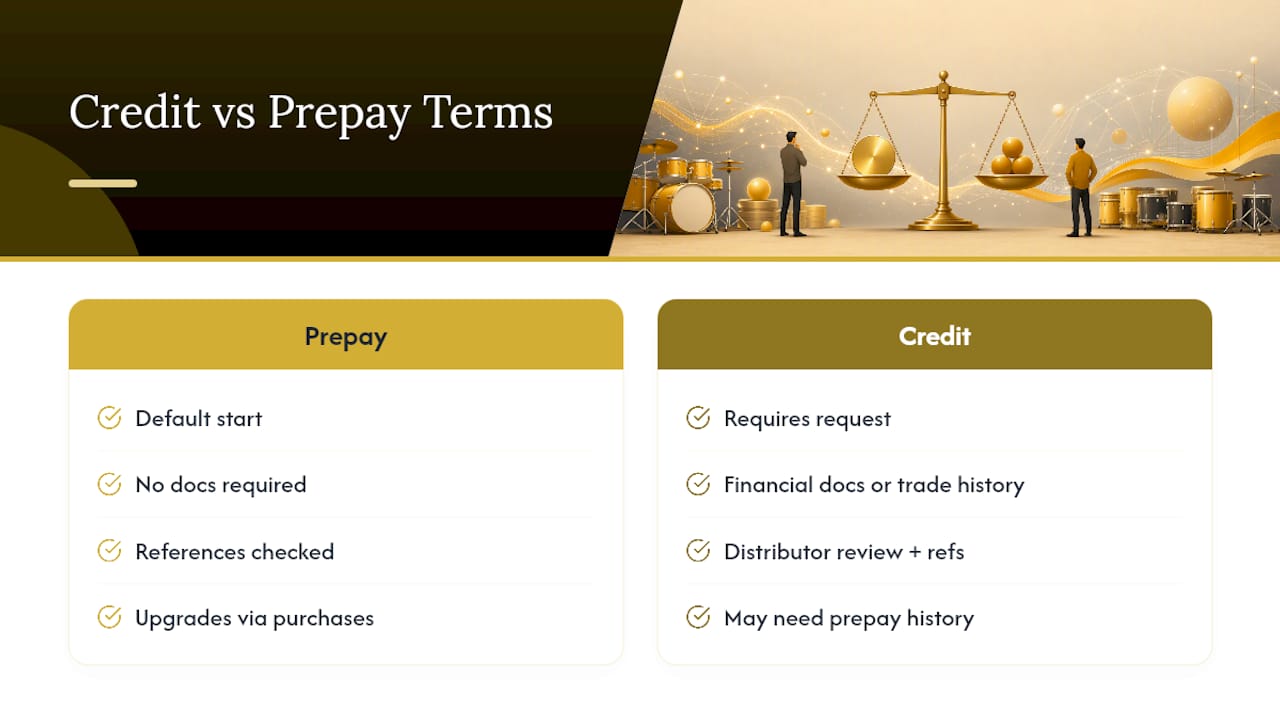
One statistic worth planning around: new accounts are commonly placed on a default lower discount tier until purchase history justifies an upgrade, according to dealer program structures, according to wholesale dealer terms across the music trade. Don’t expect top-tier pricing on order one.
Submit supporting documents as PDFs where possible. Photos of your shop or screenshots of your website work fine as JPEGs, but keep file sizes reasonable so nothing bounces from an email inbox.
What Discount Tiers and Fees Should You Expect?
Trade accounts almost always run on a tiered structure, and understanding it upfront prevents budget surprises later.
- Class C (entry tier): Typically the starting point for new accounts, with the smallest discount off list price and often a prepay requirement.
- Class B (mid tier): Reached after a few months of consistent ordering, usually with better discounts and lower per-order minimums.
- Class A (top tier): Reserved for established, high-volume accounts, often with net payment terms and priority stock access.
New accounts typically prepay by card until sales history supports an upgrade or credit terms, a pattern confirmed across multiple dealer program structures. Established accounts with a track record move toward invoiced terms, sometimes requiring financial statements to qualify.
Beyond the tier itself, budget for a few common fees: restocking charges on returned goods, cancellation fees on orders already in production (relevant for anything custom, like made-to-order drumsticks), and manual processing fees if your order comes in outside the standard online portal.
Sales channel matters too. If you plan to sell through an online marketplace, a warehouse club, or any off-price channel, expect to declare that upfront. Distributors commonly require separate approval for these channels and can suspend shipments if you start selling through an unapproved channel after the fact.
How Long Does Approval Take?
Most trade applications process within a few business days once every field and document is complete. Here’s what affects that timeline:
- Missing resale certificate or tax ID. This is the single most common hold, and it stops review cold until you supply it.
- Incomplete or unreachable trade references. A reference with no working phone number or email adds days, not hours, to your file.
- Bank verification mismatches. If your bank details don’t match your registered business name, expect a manual check.
- Undeclared sales channels. If you mention an online marketplace later that wasn’t on your original application, expect a pause while it gets separately approved.
If your application sits longer than a week with no update, follow up directly, quote your business name and the date you submitted, and attach your resale certificate again in case it didn’t come through cleanly.
Accounts left inactive for an extended stretch, commonly 12 to 24 months in industry dealer terms, can be closed or flagged for reactivation, which usually means resubmitting your original documents rather than starting from zero.
Managing Your Account After Approval
Once you’re approved, ordering gets simpler fast. Most distributors move you onto a dealer portal for repeat orders, with your tier pricing already applied, a pattern common across percussion and music wholesale programs. Your first order is typically prepaid by card. After that, if you’re still on prepay, subsequent orders follow the same pattern until you qualify for an upgrade.
A few operational basics to keep in mind:
- Shipping responsibility and drop-ship rules vary by distributor. Confirm who covers freight before assuming it’s included.
- Damaged goods should be reported promptly, with photos, since claims windows are often short.
- Returns typically carry a restocking fee unless the item arrived defective or was shipped in error.
- Ordering consistently, even in smaller amounts, keeps your account active and builds the history needed for a tier upgrade.
Pro Tip: Set a recurring calendar reminder to place at least one order every quarter, even a small restock. It’s the easiest way to avoid an inactivity flag and keeps your account moving toward better terms.
Why Register a Trade Account With Temple of Sound?
Temple of Sound Ltd is the UK’s exclusive distributor for the London Drumstick Co. and Alchemist Cymbals, which means a trade account here gets you direct access to product lines you won’t find through general wholesale channels. That exclusivity matters if you’re stocking a shop and want inventory your competitors can’t simply order from a generic supplier.
Beyond exclusivity, a Temple of Sound trade account brings:
- B2B pricing structured around genuine trade volume, not inflated list prices
- Curated cymbal packs built for retailers who want a ready-to-shelve assortment
- Membership benefits layered on top of standard trade pricing for qualifying accounts
- A custom stick builder program you can offer as a value-add to your own customers
Exclusive UK distribution of the London Drumstick Co. and Alchemist Cymbals means trade partners get first access to product lines built specifically for professional and working drummers, not mass-market alternatives.
If you’re ready to apply, the trade account application is the place to start, and it walks you through the same document checklist covered above.
The Real Bottleneck Isn’t the Form. It’s the Prep.
Most guides to trade account setup treat the application form as the hard part. It isn’t. The form takes fifteen minutes if your documents are ready. The actual bottleneck is applicants who start the form before they’ve pulled together a resale certificate, confirmed their trade references will actually answer the phone, or thought through which sales channels they plan to use.
Conventional advice tends to oversell the discount tier conversation, as if picking the right classification is the make or break moment. It isn’t. Distributors adjust tiers based on order history regardless of what box you check on day one. What actually determines your first impression is document completeness, since that’s what triggers a hold versus a same-week approval.
If you take one thing from this guide, prioritize your trade references and your resale certificate before you open the application. Everything else, tier progression, credit terms, portal access, sorts itself out once you’re actually buying.
— Will
Ready to Apply for Your Trade Account?
Temple of Sound gives drum shops and individual retailers something most general percussion distributors can’t: exclusive UK access to the London Drumstick Co. and Alchemist Cymbals, paired with a trade application process built around the exact documents covered in this guide. You already know what to prepare, resale certificate, business registration, bank details, and trade references, so there’s no guesswork left when you sit down to apply.

Whether you’re stocking a physical shop, running an online storefront, or buying for a studio, the application walks through business classification and payment setup in a way that matches everything outlined above. If you’ve gathered your documents, the next step is straightforward: head to the trade account page and submit your application today, then watch your inbox for confirmation.
Sources
- Bourne Music Company trade application
- International Music Co. Dealer Application
- Kronig Supply business account application
- LS&Co. account application and channel approval rules