20 August 2026
How to Prepare a Winning Drum Endorsement Application
How to Prepare a Winning Drum Endorsement Application
Send a compact press kit and a targeted pitch to the right person, not a scattergun email to a general inbox. A drum endorsement application that actually gets read has four fixed parts: a one-page bio, a short demo, professional photos, and links to your active social or streaming profiles.
Before writing a word, check the brand’s website for a formal endorsement form or a named artist-relations contact. If neither exists, a well-crafted email to that department works too.
Assemble these items first:
- One-page bio with your playing background and current gear setup
- A 2 to 3 track demo, either MP3 links or a short streaming playlist
- One high-quality performance photo and one clean headshot
- Links to your active Instagram, YouTube, or TikTok profiles
- A one-line pitch explaining why you and the brand fit
Key Takeaways
A strong drum endorsement application pairs a concise, well-labeled press kit with a targeted pitch sent to the right artist-relations contact, then follows brand expectations after acceptance.
| Point | Details |
|---|---|
| Build the core kit | Include a bio, photos, a short demo, and active social links before contacting any brand. |
| Prove reach first | Document consistent gear use and audience engagement before you pitch, not after. |
| Target the right contact | Use the brand’s endorsement form or artist-relations email, never a generic inbox. |
| Expect a 4 to 8 week wait | Follow up once, politely, after that window closes. |
| Honor the partnership | Use the gear publicly, credit the brand, and respond to feedback requests promptly. |
| Explore Temple of Sound | Contact Temple of Sound for product access and distribution support while building your application. |
Table of Contents
- What Does a Drum Endorsement Application Actually Get You?
- Who Gets Accepted for a Drum Endorsement?
- What Belongs in Your Application Package?
- How Do You Actually Submit an Endorsement Application?
- How Long Does the Endorsement Process Take?
- What Happens After You’re Accepted?
- How Temple of Sound Supports Artists Seeking Endorsements
- How Do You Tailor an Application to a Specific Brand?
- Why Do Most Endorsement Applications Get Rejected?
- Sources
What Does a Drum Endorsement Application Actually Get You?
An endorsement is not free gear for posting a photo. It’s a working partnership: the brand supports your playing, and you represent the brand publicly, consistently, and credibly.
Most arrangements start small. You might get a discount on gear or a single free item in exchange for using and mentioning the product. Higher tiers open up store placement, press features, and, for a small number of high-profile artists, paid campaign work. Brands rarely publish these tiers outright, but the pattern holds across the industry: the more reach and reliability you bring, the more they invest back.
That selectivity matters. Companies field far more applications than they can accept, and many treat endorsement deals as contractual, with specific expectations written into the agreement. Before you apply, know what you’re offering in return:
- Product access in exchange for regular, visible use
- Store and PR exposure tied to your existing audience
- A tiered relationship that can grow if you deliver consistently
- A written or informal agreement outlining what’s expected from you
Who Gets Accepted for a Drum Endorsement?
Artist-relations teams look for measurable signals before they look at talent alone. Reach counts. Consistent, high-quality content across YouTube, Instagram, or TikTok is one of the clearest drivers of endorsement interest right now, and a smaller but highly engaged following often beats a large, passive one.
Teaching counts as reach too. A drum instructor with 40 private students and a modest following can represent a brand’s presence in a local market just as well as a touring musician. What else moves the needle:
- Performance credentials: touring history, session credits, recorded releases
- Professional backing: management, a booking agent, or a label relationship
- References from other endorsed artists or industry contacts
- Genuine, documented use of the gear you’re pitching for, not gear you just admire
The most successful applicants build their own platform and prove regular use of the gear before they ever ask for anything, according to the step-based approach many endorsed drummers describe. Cold outreach with no track record rarely converts.
Pro Tip: Post a short clip of you playing the exact model you’re pitching for, weeks before you apply. Brands check your feed, and existing proof beats promises every time.
What Belongs in Your Application Package?
Artist-relations staff review dozens of submissions a week. Keep files short and clearly labeled so they can assess you in under a minute.
- One-page bio (PDF) covering your background, style, and current setup
- One-line pitch stating why this specific brand fits your playing
- High-resolution playing photo, properly named (not “IMG_4821.jpg”)
- Professional headshot
- Demo audio: 2 to 3 tracks, MP3 at 128 to 320kbps, or a shareable link
- Video demo: 30 to 90 seconds, shot at 720p or 1080p
- Links to active social and streaming profiles
Optional additions strengthen a borderline application: press clippings, a tour schedule, a couple of professional references, or a technical rider if you’re gigging regularly. Industry insiders consistently recommend keeping demos to a handful of tracks and videos under 90 seconds, since longer submissions get skimmed, not watched in full.
Pro Tip: Compress everything into one ZIP file or a single cloud share link. A reviewer juggling six email attachments is a reviewer who moves on to the next applicant.
How Do You Actually Submit an Endorsement Application?
Start by locating the right channel. Some brands run a dedicated endorsement form on their site; others expect a direct email to an artist-relations contact listed on the company page or found through a distributor. Check both before assuming there’s no process.
Structure your outreach like this:
- Subject line: “Drum Endorsement Application — [Your Name], [Your City]”
- Opening: three sentences covering who you are, what you play, and why this brand
- Evidence: three bullet points covering reach, credentials, and current gear use
- Closing: a list of attachments and links, clearly labeled
A tight outreach email reads faster than a long one, and reviewers reward that.
- Wait 4 to 8 weeks before following up
- Send one polite, short follow-up, never a second reminder a week later
- If you know a currently endorsed artist, ask if they’ll pass your name along
That last point carries more weight than most applicants realize. Artist-relations teams are a small, interconnected community, and a referral from someone already on the roster often moves an application to the top of the pile.
How Long Does the Endorsement Process Take?
Patience matters here. Most brands take several weeks to respond, and some forms state that range outright. Silence at week three is normal, not a rejection.
Reviewers are checking a short list during that window: your audience reach, how well you fit the existing roster, whether you have professional backing, and whether your references check out. An internal referral from a current endorsee often shortens this timeline because it skips a layer of vetting.
Three outcomes are possible:
- Accepted with terms: you’ll receive a written agreement outlining product tier and expectations
- Waitlisted: the brand keeps your file and may reach out when a roster slot opens
- Declined: some brands include brief feedback on what would strengthen a future application
What Happens After You’re Accepted?
Getting the “yes” is the easy part. Keeping the relationship healthy is the actual job. Endorsees are expected to act as working ambassadors: use the gear visibly and consistently, credit the brand in posts and performances, and take part in the occasional campaign or product test the brand asks for.
Stay responsive. Some brands expect periodic activity reports or check ins about how the gear performed on tour or in the studio.
- Use the product publicly and consistently, not just for the announcement post
- Credit the brand by name or tag in relevant content
- Respond to campaign requests and feedback surveys promptly
- Avoid mixed messaging, like praising a competitor’s gear right after signing
Inconsistent use is the fastest way to lose a tier or get quietly dropped at renewal.
How Temple of Sound Supports Artists Seeking Endorsements
Temple of Sound is the UK’s exclusive distributor for London Drumstick Co. and Alchemist Cymbals, and we work directly with drummers building toward their first or next endorsement.
- Product access to handcrafted drumsticks and B20 cymbals for genuine, documented use
- Distribution reach across UK retailers, useful for artists building store-level visibility
- A community of working drummers and percussionists who can offer feedback and references
- A direct point of contact through Temple of Sound for artists exploring a partnership
If you’re not sure whether your current reach or credentials fit a specific brand’s roster, reaching out to us directly is a reasonable first step before you approach a bigger name.
How Do You Tailor an Application to a Specific Brand?
A generic pitch sent to five brands at once reads exactly like what it is. Every brand has a distinct roster identity, and matching yours to theirs is what separates a form-letter submission from one that gets a reply.
Start by researching the brand’s current artists. If their roster leans toward metal and hard rock, a jazz-focused demo won’t land, no matter how strong your playing is. Mention specific products by name in your pitch, not “your gear” generically. If you’re applying to a boutique cymbal maker, reference the exact model line you already play and explain why it suits your style.
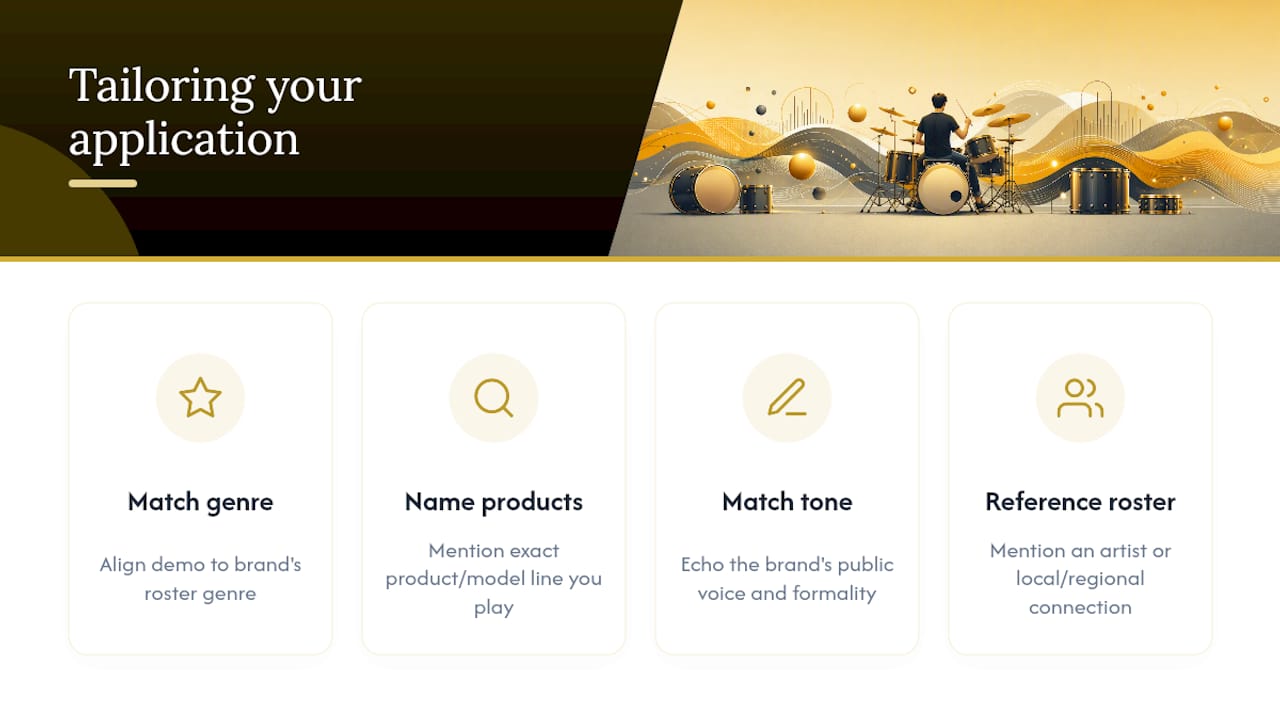
Match your tone to the brand’s public voice too. A family-run percussion company and a global drum conglomerate expect different levels of formality in an application email. Read a few of their social posts or artist features before you write your pitch, and echo that register.
Smaller, independent brands often respond better to a direct, personal pitch than a templated one, since a well-crafted, individual approach tends to outperform a mass application sent to a dozen companies at once. Reference something specific: a product line, an artist on their roster you admire, or a regional connection if the brand is smaller and community-focused. That specificity signals you did the homework instead of copy-pasting the same three paragraphs everywhere.
Why Do Most Endorsement Applications Get Rejected?
The most common reason isn’t talent. It’s mismatch or incompleteness, and both are avoidable.
A pitch with no evidence of reach, no photos, and a vague “I love your brand” line gets filed and forgotten. Brands need proof you’ll represent them well publicly, and demonstrating value rather than asking for free product is the difference between a serious applicant and someone hoping for a handout.
Other frequent missteps:
- Applying before you have any real social presence or gig history to point to
- Sending oversized files or a dozen separate attachments instead of one clean package
- Pitching gear you don’t actually own or use, which shows up fast in follow-up questions
- Ignoring the brand’s stated response window and sending three follow-ups in two weeks
- Applying to a brand whose roster and price tier don’t match your current level at all
Fixing most of these takes patience, not talent. Build your platform first, document real gear use over weeks or months, then apply with a package that’s tight, honest, and specific to the one brand you’re pitching. Roster moves happen constantly across the industry, as regular endorsement announcements show, which means slots do open. Timing and preparation matter more than luck.
A Short Word on Mindset
Treat an endorsement as a partnership you’re earning, not a prize you’re owed. Brands remember consistency far more than a single polished pitch. Show up, keep playing, and let the relationship build over months, not one email.
Get Product Access and Artist Support Through Temple of Sound
If you’re building your case for an endorsement, having the right gear in hand matters as much as the pitch itself. Temple of Sound gives working drummers direct access to handcrafted London Drumstick Co. sticks and Alchemist Cymbals’ B20 cymbals, the kind of professional-grade gear that makes your demo footage and photos genuinely credible instead of borrowed.
Beyond product access, Temple of Sound connects artists with UK distribution reach and a community of drummers who understand what artist-relations teams are actually looking for. If you’re preparing an application and want to talk through your gear setup or explore a direct partnership, visit the Temple of Sound site to check current programs and get in touch. That conversation costs nothing, and it might save you weeks of guessing what a brand wants to see.
Sources
- How to Get Drum Endorsements: The Truth Behind Sponsorships
- 5 Steps to Getting Endorsed (The Right Way)
- Inside the secret world of drum endorsements