15 August 2026
Bass Drum Beater Types: Choose by Attack, Warmth, Weight
Bass Drum Beater Types: Choose by Attack, Warmth, Weight
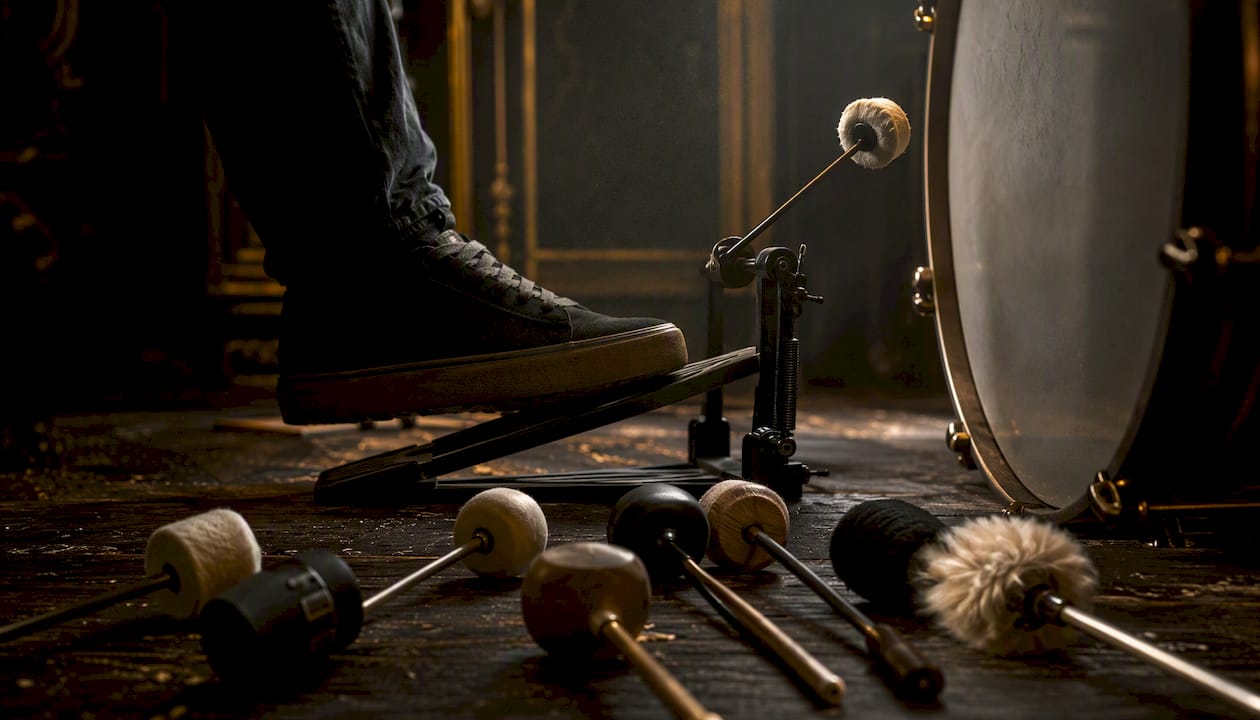
Every bass drum beater falls into one of seven families: felt, fluffy/fleece, rubber, plastic or nylon, wood, leather or hybrid, and brush/textile. Add reversible beaters that combine two of those surfaces in one shaft, and you’ve got the full menu. Shape matters as much as material: spherical heads stay consistent no matter your angle, while flat or conical faces punch harder and cut through a mix.
If you want the fast version: grab a soft felt or fleece beater for warm jazz and low-volume rooms, a medium felt or rubber beater for everyday rock and pop, and a hard plastic or wood beater when you need metal-grade attack. Start by deciding whether you want warmth or attack first. Everything else, shape, weight, surface, follows from that one decision.
- Soft: felt or fleece, spherical head, light shaft
- Medium: dense felt or rubber, curved head
- Hard: plastic, nylon, or wood, flat or conical head
Key Takeaways
Bass drum tone depends on beater material, head shape, and weight distribution working together, not any single factor in isolation.
| Point | Details |
|---|---|
| Match attack to warmth first | Decide whether you need warmth or attack before picking material or shape. |
| Felt is the safest default | Density variants (soft, medium, hard) cover jazz through rock in one family. |
| Shape changes tone independent of material | Flat and conical heads increase attack; spherical and curved heads soften it. |
| Weight controls speed versus boom | Lighter beaters favor fast footwork; top-heavy beaters add low-end depth. |
| Templeofsound demo-tests before stocking | Try soft, medium, and hard options in-store or order two families for a home shootout. |
Table of Contents
- What Bass Drum Beater Types Actually Change In Your Sound
- The Main Bass Drum Beater Materials at a Glance
- Felt Beaters: The Everyday Workhorse
- Fluffy, Fleece, and Wrapped Beaters for Maximum Softness
- Rubber Beaters for Speed and Punch
- Plastic and Nylon Beaters for Maximum Cut
- Wood Beaters for Organic Attack
- Leather and Hybrid Beaters for Niche Tonal Blends
- Brush and Textile Beaters for Whisper-Quiet Playing
- How Head Shape Changes Attack Independent of Material
- Weight, Shaft Length, and Construction Details That Change Feel
- Reversible Beaters: Two Sounds, One Shaft
- Which Beater Fits Which Genre: A Quick Reference
- How to Run a 15-Minute Beater Shootout
- Compatibility, Swapping, and Basic Beater Care
- A Short Note From Temple of Sound on Choosing Beaters
- What Actually Matters When You’re Choosing a Beater
- Try Templeofsound’s In-House Tested Beater Lineup
- Frequently Asked Questions
- Sources
What Bass Drum Beater Types Actually Change In Your Sound
The physics is simple once you see it: contact area controls attack, mass controls how much energy transfers into the head, and surface hardness controls brightness. A wide, soft contact patch spreads the strike over more surface and more time, which softens the transient and lets the drum’s fundamental tone bloom. A small, hard contact patch delivers energy almost instantly, producing a sharp click before the tone even develops.
Picture it as a diagram: on one end, a rounded felt ball flattens slightly on impact, spreading force and rolling off high frequencies. On the other end, a flat plastic disc hits like a hammer, no give, no spread, all click. Everything else on the beater spectrum sits somewhere between those two extremes.
Four factors do almost all the work:
- Attack and sharpness. Harder, flatter surfaces create a faster, more defined transient that shows up clearly on a recording.
- Tonal color and warmth. Softer, more compliant materials absorb high-frequency energy and let the drum’s low-mid resonance dominate.
- Sustain and control. Lighter beaters with soft heads tend to let the head ring longer after the initial hit; heavier or harder beaters can choke sustain slightly by damping the head on contact.
- Projection and mix presence. A brighter, higher-frequency attack cuts through cymbals and distorted guitars far more reliably than a warm, rounded thump.
Pro Tip: If your bass drum disappears in a live mix, the fix is rarely more volume. Swap to a harder, flatter beater first. You’ll often solve the problem without touching a single fader.
The Main Bass Drum Beater Materials at a Glance
Seven material families cover nearly every beater on the market: felt, fluffy/fleece, rubber, plastic/acrylic/nylon, wood, leather or hybrid builds, and brush/textile heads. Reversible beaters simply mount two of these on opposite ends.
- Felt: warm, versatile, the default choice for most drummers
- Fluffy/fleece: maximum softness, orchestral and acoustic settings
- Rubber: fast rebound, punchy and focused
- Plastic/nylon: brightest attack, cuts through loud mixes
- Wood: organic midrange punch, vintage character
- Leather/hybrid: blended warmth and definition, niche appeal
- Brush/textile: near-silent attack, low-volume and studio work
Felt Beaters: The Everyday Workhorse
Felt earns its reputation as the most versatile beater family because manufacturers press it into a range of densities. That single variable, soft, medium, or hard felt, lets one material cover everything from a Sinatra ballad to a hard rock set.
What felt gets right and where it struggles:
- Warm, rounded tone that blends naturally with most tuning ranges
- Wide range of hardness options in a single, affordable family
- Compresses and hardens with use, changing tone gradually over months
- Slightly less projection than plastic or rubber in very loud settings
Soft felt suits jazz, acoustic, and singer-songwriter gigs where you want the drum to breathe. Medium felt is the general-purpose choice most touring drummers keep on their pedal by default. Hard felt pushes toward rock and pop, giving more click without going full plastic. Pairing matters too: a looser front head tends to sound muddier with soft felt, so many drummers tighten resonant head tension slightly when they size down in beater hardness, and move the mic a few inches closer to the head to recover detail.
Pro Tip: Squeeze the felt head between your thumb and finger before buying. If it barely gives, it’s on the harder end regardless of what the label says. Felt also packs down and hardens naturally as it ages, so a beater that felt soft out of the box may play medium after a year of regular gigs.
Fluffy, Fleece, and Wrapped Beaters for Maximum Softness
Fleece and fluffy wrapped beaters produce the softest possible impact and the warmest low-frequency bloom of any beater family, with almost no audible click. They’re the choice when the room, or the recording, can’t tolerate any beater noise at all.
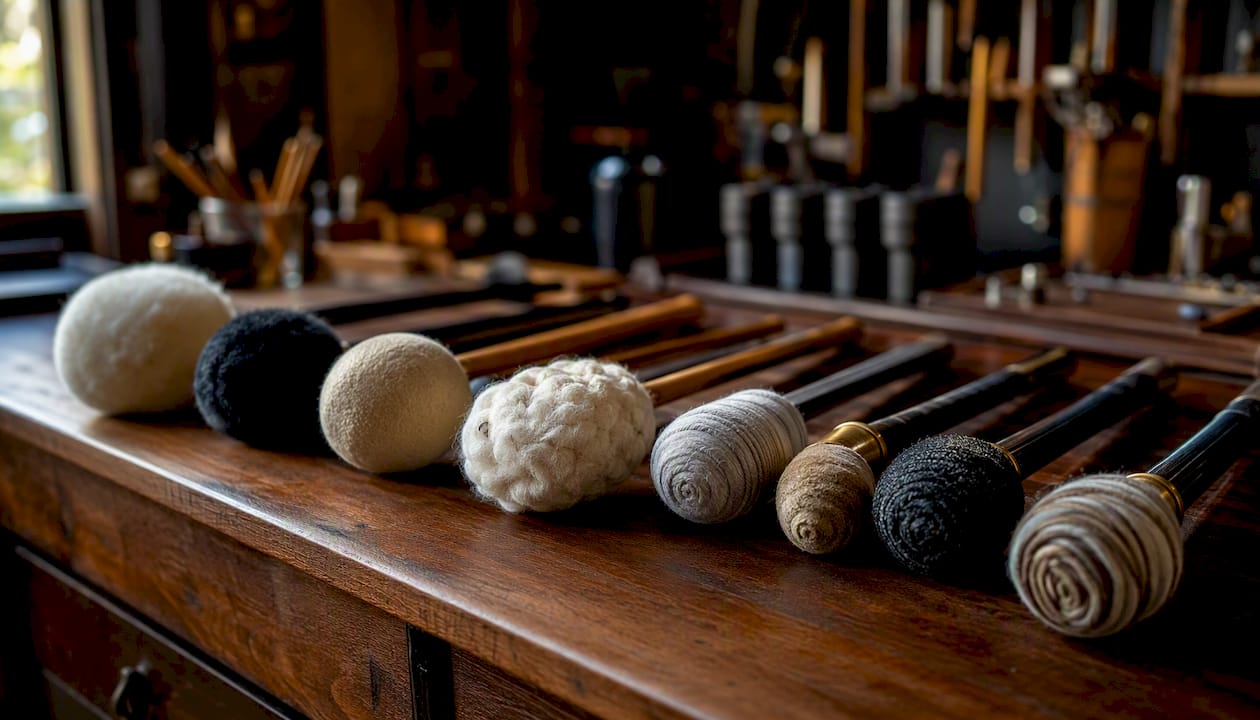
You’ll find these in orchestral pit work, small jazz clubs, and acoustic singer-songwriter sets where a bass drum needs to sit under the music rather than announce itself. Studio engineers reach for fleece beaters constantly when a track calls for low-end weight without a transient that fights the kick sample layered underneath it.
Wrapped beaters do wear out, though. The yarn or cloth compresses and frays with repeated strikes, and a compressed wrap starts behaving more like felt than fleece. Replace the wrap, or the whole beater, once you notice the softness fading. Because these beaters spread contact so widely, they also tend to be gentler on drumhead longevity than harder, more concentrated surfaces.
Rubber Beaters for Speed and Punch
Rubber beaters favor fast rebound and a fat, punchy attack, which is exactly why double-kick drummers and funk players gravitate toward them. The bounce-back speed lets your foot recover faster between strokes, a real advantage once tempos climb past comfortable territory.
The tradeoffs to know:
- Faster rebound than felt, which helps with speed-dependent techniques
- Strong, focused low-mid punch that holds up in a dense mix
- Can sound hyper-focused or one-dimensional compared to felt’s tonal range
- Durometer (rubber hardness) varies significantly between models, so “rubber” isn’t one sound
Manufacturers vary durometer specifically to shift where rubber sits on the attack spectrum, and the shape and weight distribution of a beater changes that projection as much as the rubber compound itself does. Metal, fast rock, and funk are rubber’s natural homes. Pair it with a slightly looser batter head to soften rubber’s tendency toward a hyper-clicky edge, and most players find the pedal’s natural spring tension needs a touch more tightening to match rubber’s snappier rebound.
Plastic and Nylon Beaters for Maximum Cut
Plastic and nylon beaters deliver the most defined, brightest attack of any material family, with projection that holds up at any volume. When a mix needs the kick to cut through distorted guitars and crash cymbals without turning the volume up, this is the surface that does it.
Metal and hard rock drummers reach for plastic constantly, and it’s the standard hard side on most reversible beaters for exactly that reason. The tradeoff is real: plastic can tip into harsh, brittle territory if your batter head is already bright and tightly tuned.
To keep articulation without the harshness, drop the batter head tension slightly to add a touch of warmth back into the fundamental, and keep the front-head mic a few inches off-axis from dead center to avoid capturing an overly clicky transient. A small piece of moleskin on the head at the strike point can also soften plastic’s edge without sacrificing much definition.
Wood Beaters for Organic Attack
Wood beaters produce a warm, organic attack with pronounced midrange presence and a transient that feels immediate and percussive, closer to a mallet on a temple block than a conventional beater. It’s a distinct tonal color that neither felt nor plastic quite replicates.
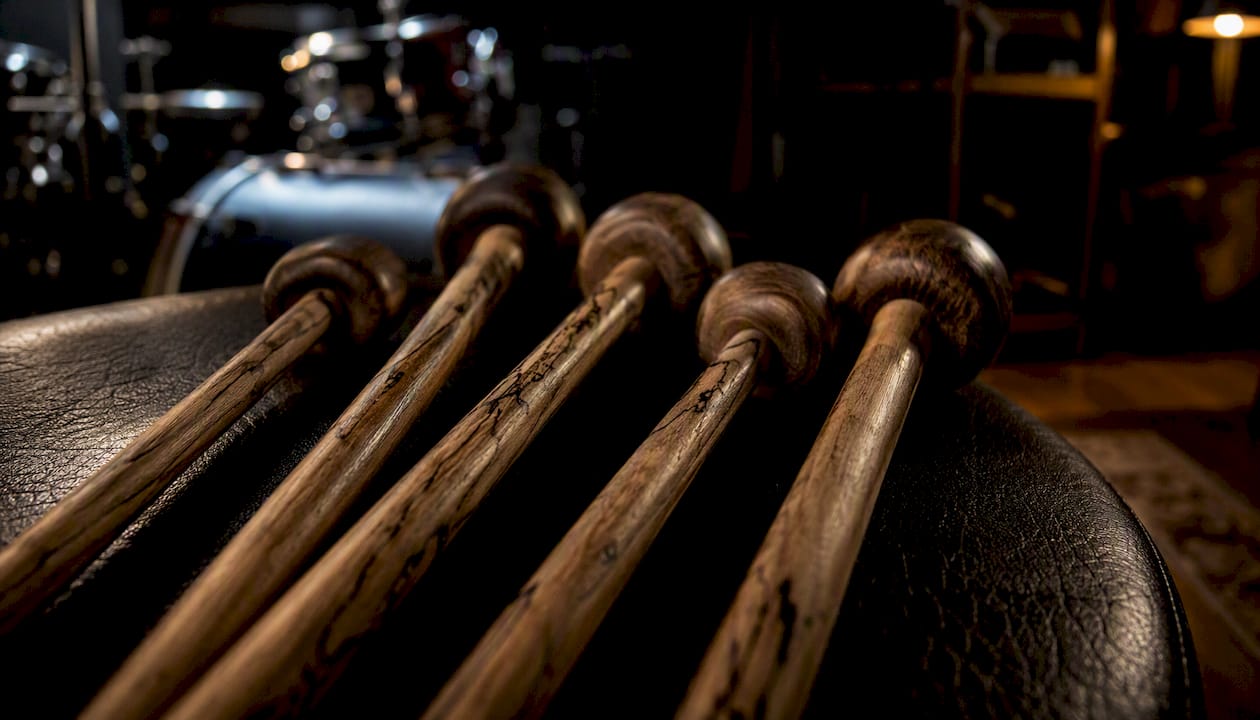
Pro Tip: Wood surfaces wear the head faster than felt or rubber. Many wood beaters ship with, or accept, a replaceable cap that takes the impact instead of the beater itself. Swap the cap when it shows flat spots or splitting, and your tone stays consistent gig after gig.
Vintage-leaning genres, roots rock, Americana, and certain jazz contexts benefit most from wood’s coloration. It outperforms plastic when you want attack without brightness, and outperforms rubber when you want a more textured, less rubbery midrange punch.
Leather and Hybrid Beaters for Niche Tonal Blends
Leather and hybrid beaters, stacked leather discs, leather-wrapped cores, or combination builds, blend organic warmth with a more focused attack than pure felt delivers. They’re a natural fit for vintage-style kits and recording sessions chasing a specific old-school tone.
Session drummers reach for these when a track needs punch without any of the high-mid edge that plastic or hard rubber introduces. A leather-faced beater can split the difference convincingly on a ballad that still needs some definition.
These beaters cost more than standard felt or plastic models, and leather wears unevenly over time compared to synthetic materials. The tonal payoff is real for the right session, but it’s a specialist tool rather than an everyday workhorse.
Brush and Textile Beaters for Whisper-Quiet Playing
Brush-style and textile-wrapped beaters cut attack down dramatically, making them the right call for coffeehouse gigs, unplugged acoustic sets, and studio passes where even a fleece beater reads as too loud.
They pair naturally with a lightly damped head, since you’re already chasing minimal transient energy and don’t want extra ring fighting against the softness. Compared to felt or rubber, brushes let more of the drum’s natural low-end body come through relative to the click, because there’s almost no click to compete with it.
Pro Tip: Move the kick mic closer than you normally would with brush beaters. You need proximity to capture body, since there’s so little transient energy for the mic to lock onto.
How Head Shape Changes Attack Independent of Material
Shape reshapes tone as much as material does. A flatter beater face increases contact area at the moment of impact and boosts attack projection, while a curved or spherical face reduces that contact area and softens the strike, according to research on bass drum beater design. Two felt beaters, one spherical, one flat, will sound noticeably different even with identical density.
- Spherical: consistent response no matter the angle you strike from; forgiving for developing players
- Curved/contoured: slightly softer than flat, rounder tone, common on general-purpose beaters
- Conical: narrows contact to a point, sharper attack than a sphere of the same material
- Flat/cube: maximum contact area and attack, often paired with hard plastic for metal
- Reversible/multi-faced: two shapes or materials on one shaft for quick switching
The combinations that consistently work: soft felt on a spherical head for jazz, medium felt on a curved head for general rock and pop, and hard plastic on a flat or conical head for metal and modern hard rock.
| Shape | Contact Area | Attack Character | Best Pairing |
|---|---|---|---|
| Spherical | Consistent, moderate | Balanced, forgiving | Felt, general playing |
| Curved | Moderate | Softer, rounder | Felt or rubber, versatile use |
| Conical | Narrow | Sharp, focused | Wood or hard felt |
| Flat/cube | Maximum | Strongest attack | Plastic, metal genres |
Weight, Shaft Length, and Construction Details That Change Feel
Moving mass and balance point change how energy transfers into the head. Top-heavy beaters push more mass into the strike, adding boom and low-end depth, while lighter designs favor speed and quicker foot response. Orchestral mallet builders exploit this constantly, deliberately shifting balance points for specific tonal outcomes, heavier for a bigger boom, lighter for faster rolls, and the same logic applies directly to kit beaters.
If your current beater feels sluggish on fast patterns, try a lighter head or a shorter shaft before blaming your technique. If your bass drum sounds thin no matter what head you swap in, adding weight, or switching to a top-heavy model, often solves it faster than retuning the drum.
Pro Tip: Some beaters ship with removable weights near the head. Adding or removing even one weight changes the felt sensation of “boom versus speed” more than most drummers expect.
Shaft material matters less than most drummers assume, but hinge-style versus straight rods change how the beater angle responds to your ankle motion, and most modern pedals accept both without modification. Universal fit is common but not guaranteed, so it’s worth checking the mounting hardware before ordering.
Reversible Beaters: Two Sounds, One Shaft
Reversible beaters mount two different surfaces, felt and plastic, or hard felt and rubber, on opposite ends of the same shaft, letting you switch attack character in seconds without changing beaters entirely.
- Loosen the mounting screw, rotate the shaft 180 degrees, and re-tighten. Most designs take under ten seconds once you’ve practiced it.
- Mark your preferred side with a small strip of tape if your set list alternates between quiet ballads and loud closers.
- Make micro-adjustments to strike angle after swapping. The two sides often sit at slightly different distances from the head.
A dedicated single-surface beater still wins when you know exactly what a whole set demands. Reversible beaters shine specifically when dynamics swing hard within one performance.
Which Beater Fits Which Genre: A Quick Reference
Genre gives you a strong starting point, even before you factor in personal taste. Editorial roundups consistently note that the right beater depends heavily on playing style and price, so treat this as a launch point, not gospel.
| Genre/Setting | Recommended Material | Shape | Weight |
|---|---|---|---|
| Jazz/acoustic | Fleece or soft felt | Spherical | Light |
| Rock/pop | Medium felt or rubber | Curved | Medium |
| Metal/hard rock | Plastic or hard rubber | Flat/conical | Medium to heavy |
| Funk | Rubber | Curved | Light to medium |
| Studio/recording | Fleece, felt, or brush | Varies by take | Light |
| Vintage/Americana | Wood or leather | Conical | Medium |
Mic technique and tuning shift these recommendations in practice. A tightly tuned resonant head with a small port hole already adds attack on its own, so pairing it with a hard plastic beater can push you into harsh territory. If you gig across multiple genres in one night, a reversible felt-and-plastic beater, or a medium felt beater, covers the widest range without forcing a compromise anywhere.
How to Run a 15-Minute Beater Shootout
Comparing beaters by feel alone is unreliable. Your ear adjusts within a few strikes, so a structured method catches differences you’d otherwise miss.
- Tune your bass drum once and don’t touch it again during the test.
- Mark one consistent strike point on the head with a small piece of tape.
- Practice a single, repeatable stroke, same speed, same pedal pressure, and use it for every beater.
- Set a mic at a fixed distance (12 inches inside the port, or your usual placement) and don’t move it between beaters.
- Record five strikes per beater at consistent tempo, then move to the next.
- Listen back in order, comparing attack sharpness, sustain length, low-end body, audible click, and how each sits against a reference track or a loop of your band’s mix.
Document the tempo, head brand, and mic distance for every test. Video shootouts posted online are useful references, but your own room and your own drum will always sound different from someone else’s.
Compatibility, Swapping, and Basic Beater Care
Most modern beaters fit standard bass drum pedals, but shaft diameter and threaded mounting hardware vary enough between brands that it’s worth checking before you buy, especially with vintage or off-brand pedals.
- Confirm shaft diameter matches your pedal’s beater clamp before ordering
- Check whether the mounting uses a threaded fitting or a simple clamp screw
- Universal adapters exist for mismatched diameters, but they add a small amount of play
- Fluff felt periodically with a wire brush to slow natural hardening
- Replace fraying wraps on fleece or yarn beaters before they compress fully
- Use a sacrificial cap or moleskin patch on wood or hard plastic beaters to protect the head
A beater that’s slipping in its clamp is a safety issue as much as a tone issue, so retighten mounting hardware regularly rather than waiting for a gig to expose it.
A Short Note From Temple of Sound on Choosing Beaters
Templeofsound prioritizes tonal range, build quality, and hands-on demo testing when we select beaters to carry. We’d rather stock four materials that genuinely differ in feel than a dozen variations on the same felt density.
- Try beaters in-store against your own kit whenever that’s an option
- Order two contrasting families, soft and hard, for a home shootout if you can’t test in person
- Ask about workshop demo sessions if you’re deciding between shapes, not just materials
We test gear in-house before recommending it, and we’re always glad to talk through what a specific room or genre needs.
What Actually Matters When You’re Choosing a Beater
Most buying guides treat beater choice like a genre lookup table: metal gets plastic, jazz gets fleece, done. That’s a reasonable starting point, but it undersells how much shape and weight change the equation independent of material. A hard felt beater on a flat head can out-punch a soft plastic beater on a rounded one. Genre tells you roughly where to start; shape and mass tell you how far you can push in either direction without switching materials entirely.
The bigger blind spot is that most drummers never revisit their beater choice after the first purchase. Felt hardens, wraps compress, and a beater that sounded right a year ago may have drifted toward a different tonal character without anyone noticing. If your kick tone has felt “off” lately and you’ve already checked tuning and heads, the beater itself is worth a second look before anything else.
Prioritize attack versus warmth first, shape second, weight last. Weight is the easiest variable to compensate for with technique. Material and shape are not.
Try Templeofsound’s In-House Tested Beater Lineup
Templeofsound stocks beaters across the soft, medium, and hard spectrum, felt, rubber, plastic, and reversible builds, each one demo-tested in-house before it goes on the shelf rather than selected off a spec sheet. If you’re deciding between a warm felt beater and a punchier plastic one, that’s exactly the kind of comparison our team runs before recommending anything.

For readers who aren’t sure which family fits their kit, ordering two contrasting types, a soft felt and a hard plastic, gives you a real shootout at home for less than the cost of guessing wrong twice. A reversible beater is the economical middle path if you play mixed sets and don’t want to carry two separate beaters to a gig. Members get ongoing discounts on accessories like these, which makes experimenting with a second or third beater far less of a financial gamble. Head to the Temple of Sound shop to browse current beater stock and check what’s available for demo before you order.
Frequently Asked Questions
What’s the difference between soft and hard drum beaters? Soft beaters, felt and fleece, spread impact over a wider area and produce a warmer tone with less audible click. Hard beaters, plastic and wood, concentrate impact into a smaller area, producing a sharper, brighter attack that projects further in a loud mix.
Which bass drum beater material is best for metal? Hard plastic or nylon beaters on a flat or conical head give the clearest, most consistent attack for fast, aggressive playing. Many metal drummers also use the hard side of a reversible beater for this reason.
Do bass drum beater types really change the sound that much? Yes. Material controls brightness, shape controls contact area and attack sharpness, and weight controls how much energy transfers into the head. Changing any one of the three noticeably shifts your kick drum’s character, often more than changing the head itself.
How often should I replace a felt beater? Felt compresses and hardens with regular use, gradually shifting tone even without visible damage. Most gigging drummers replace or fluff their felt beater every few months, depending on how often they play and how hard they hit.
Can one beater work for every genre? A medium felt beater or a reversible felt-and-plastic model covers the widest range reasonably well. It won’t outperform a purpose-matched beater in any single genre, but it avoids compromise across a varied set list.
Sources
For readers who want to hear differences rather than just read about them, these sources go deeper into specific beater categories:
- What Are the Different Types of Bass Drum Beaters?
- Christopher Lamb Orchestral Series - Concert Bass Drum Beaters - Innovative Percussion